Slow-acting carbohydrates are primarily found in the following foods: Small, firm potatoes; parboiled or brown rice; wholegrain pasta; wholegrain bulgur; legumes (chickpeas, lentils, dried beans); rye bread; wholegrain bread with visible whole grains and seeds; thick-rolled oats; some fruits; and vegetables. Vegetables comprise different varieties of cabbage such as e.g., cauliflower, red cabbage, pointed cabbage, and broccoli, leeks, and most root vegetables.
Foods with slow-acting carbohydrates also contain lots of dietary fibre, which will mean a longer digestion time, thus delaying the time when the sugar will be absorbed by the blood stream. Dietary fibre also increases the feeling of satiety and reduces the risk of constipation, which can be a challenge for some pregnant women.
Fast-acting carbohydrates are primarily found in food products with added sugars, such as candy, ice cream, cake, jam, fruit yogurt, and soft drinks. In addition, they are found in foods with naturally occurring sugars such as milk, juice, fruit smoothies, fresh fruit, and dried fruit e.g., figs, dates and raisins.
Fast-acting carbohydrates are also present in starchy foods, processed foods with a low dietary fibre content e.g., bread made from finely ground flour, and various breakfast products such as cornflakes, and mashed potatoes.
Tools for limiting carbohydrates
To limit your carbohydrate intake you must know the carbohydrate content of what you eat.
You can use various tools to estimate the amount of carbohydrates in various foods:
Carb list or a carb plan
- You will find a carbohydrate plan at the back of this booklet
Use an app
- Download the Danish Diabetes Association’s app called "Kulhydrattælleren”
- Download the app called “Carbs & Cals”
- Download the app “Lifesum”
Calculate the amount of carbohydrates based on the nutrition label available for most foods
When you convert the amount of carbohydrates per 100 grams to the portion (amount) you wish to eat, you do the following:
1. Find the amount of carbohydrates available on the nutrition label. Look for the total amount of carbohydrates per 100 grams.
2. Weigh the food you wish to eat. We recommend that you begin by using a kitchen scale, to learn how to estimate the portion size of carbohydrate foods you normally eat.
3. Calculate the amount of carbohydrates. You calculate the amount of carbohydrates by dividing the number of carbohydrates per 100 grams (stated on the nutrition label) by 100. Then multiply the result by the number of grams of the food you wish to eat.
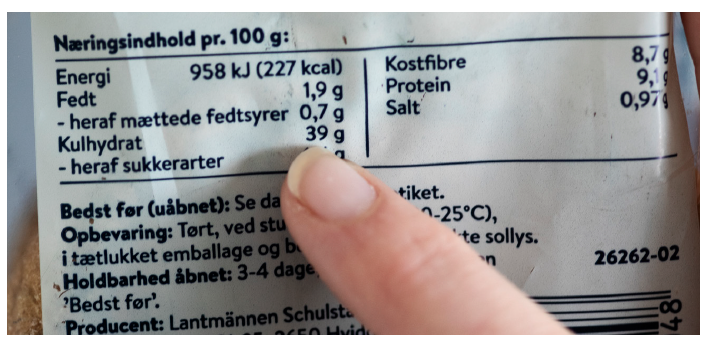
Example of nutrition label on a package of wholemeal buns.
Calculation example: 100 grams of a wholemeal bun contains 39 grams of carbohydrates. You wish to eat half of the bun which weighs 40 grams. Then the calculation looks like this:
39 grams of carbohydrates/100 * 40 = 16 grams of carbohydrates in half a bun.
Choose the right amounts with the plate method
Use the plate method resembling a “T” at each main meal to make sure you get the right amounts of vegetables every day and avoid eating too much starchy and thus high-carbohydrate foods e.g., rice, pasta, potatoes, or bread.
The Plate Method
- Fill half (1/2) of your plate with vegetables
- Fill one quarter (1/4) with potatoes, rice, pasta, or bread.
- Fill one quarter (1/4) with lean meat, poultry, or fish.
If you are on a vegetarian/vegan diet, you can fill half of your plate with pasta, rice, potatoes and legumes, and the other half with vegetables.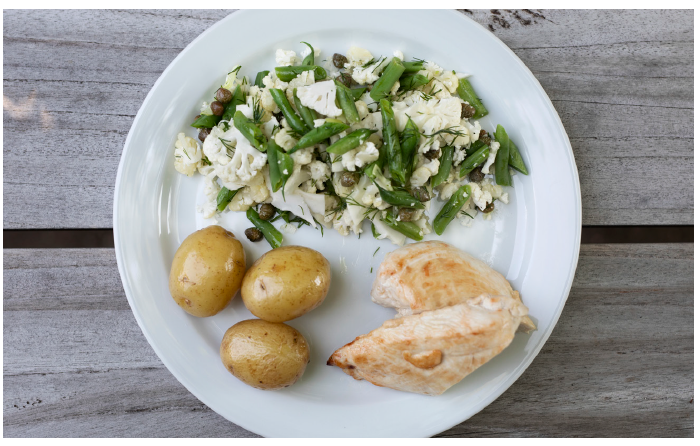
T-plate method to limit the amount of carbohydrates in your main meals
Measuring your blood sugar
When you have been diagnosed with gestational diabetes, you will be trained in how to measure and record your blood sugar values, and you will also receive equipment for monitoring your blood sugar.
Recommended target values for your blood sugar:
- Before a main meal: Max 5,5 mmol/L.
- 1½ -2 hours after a main meal: Max. 7,0 mmol/L.
It is important that you write down your measured blood sugar values and note which type and amount of carbohydrate you have eaten at each meal. This is particularly important if your blood sugar value is above the recommend level after a meal. This can help you understand which types and amounts of carbohydrate foods causes your blood sugar to rise too high.
Snacks, sweeteners, and drinks
Snacks
We recommend that you eat a maximum of 3 pieces of fresh fruit per day and only one piece of fruit per snack. One serving of fruit can be one small apple or one small pear which is usually equal to 10 grams of carbohydrates. If you have problems with very high blood sugar levels after eating fruit, we recommend that you settle for ½ a piece of fruit 1-2 times a day.
If you have gestational diabetes, each snack should be limited to about 10 grams of carbohydrates.
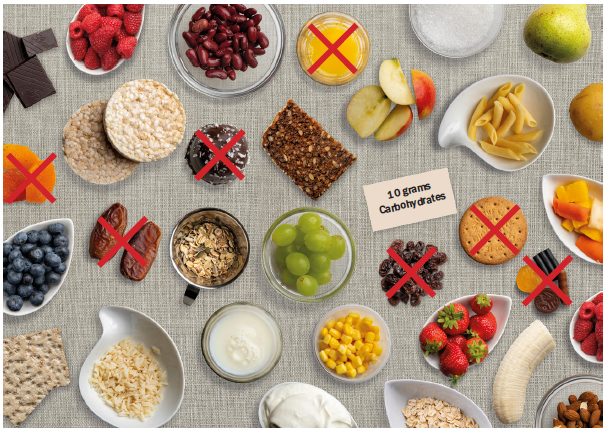
Snacks in serving sizes equivalent to 10 grams of carbohydrate.
Sugary drinks
We don’t recommend sugars from sugar-sweetened beverages such as soft drinks or from naturally occurring sugars such as juice or smoothies. Milk is the one exception (max 1 glass of milk two times a day).
Both natural and artificial sugars in liquid form will enter the blood stream very quickly, thus causing high blood sugar levels. If you want an alternative to water, we recommend that you only choose soft drinks containing artificial sweeteners that will not affect your blood sugar levels (i.e., 0 calories per 100 ml on the nutrition label). Drink water if you are thirsty. Choose drinks with artificial sweeteners. Use low-fat milk for your coffee/tea. A maximum of 2 cups of coffee/tea per day is recommended during pregnancy.
Sweeteners
Sweeteners that do not affect your blood sugar levels will pass through the digestive system unchanged and will thus not be broken down into sugar.
Sweeteners called polyols or sugar alcohols are natural sugar replacers which are converted into sugar very slowly in the body. They can make blood sugar levels rise. Not as much as sugar, however – all depending on the amount you consume.
You must be aware that if you consume large amounts of this group of natural sugar replacers at one time (more than 20-25 grams), you may experience diarrhea or other gastrointestinal problems.
Sweeteners that will affect blood sugar in an upward direction:
- Sorbitol, sorbitol syrup (E 420)
- Mannitol (E 421)
- Maltitol, maltitol sirup (E 965)
- Isomalt (E 953)
- Lactitol (E 966)
- Xylitol (E 967)
Sweeteners that will not affect blood sugar levels, i.e. not cause your blood sugar levels to rise:
- Acesulfame K/acesulfame potassium (E 950)
- Aspartame (E 951)
- Cyclamate or sodium cyclamate (E 952)
- Saccharin/saccharin or sodium saccharin/sodium saccharin (E 954)
- Sucralose/sukralose (E 955)
- Thaumatin (E 957)
- Erythritol (E 968) (Erythritol is a so-called sugar alcohol/polyol and may cause stomach problems if consumed in excess)
Remember vitamin and mineral supplements
During pregnancy, the Danish Health Authority recommends the following supplements:
- 10 micrograms (μg) of vitamin D daily throughout pregnancy
- 400 micrograms (μg) of folic acid daily, first 3 months of pregnancy.
- 40-50 milligrams (mg) of iron daily, beginning at week 10 of pregnancy.
- 250 ml. milk/dairy products + 2 slices cheese or 350 ml. milk/dairy products, if you don’t eat cheese, or 500 milligrams (mg) of calcium supplements daily, throughout pregnancy, if you don’t consume milk/ dairy products or cheese.
Be physically active
If you have gestational diabetes, physical activity together with a
healthy diet are the most important parts of managing your diabetes. By being physically active, you can scale down your blood sugar levels.
When you are physically active, the sensitivity of muscle cells to insulin increases. This means that the body’s need for insulin decreases. At the same time, blood sugar levels will be lowered because the muscle cells primarily use sugar absorbed from the bloodstream as energy.
Your blood sugar will drop both during and after physical activity. e.g., you can down-regulate your blood sugar after a meal by taking a walk.
Be active for 30 minutes every day
We recommend that you are physically active for at least 30 minutes a day. The intensity should preferably be moderate. This means that you will still be able to speak, but your sentences will be interrupted by breathing – this is also referred to as the ”speaking limit. We recommend walking 10-20 minutes after each main meal.
The type of physical activity you can do will depend on the physical activity you were used to before your pregnancy up until this moment. Even if you have not been used to exercising before you became pregnant, it is safe for you to do physical activity of moderate intensity such as walking, biking, riding or swimming.
Suggestions for exercising: walking at a brisk pace so that you reach the ”talking limit”, biking, swimming, water aerobics, dancing, exercising with rubber bands or fitness walking.
Get moving and prevent type 2 diabetes later in life
We recommend physical activity during pregnancy because it is important for you and your unborn child during your pregnancy. But also because healthy habits including regular exercise and healthy eating are highly important for both you and your child after your pregnancy.
Gestational diabetes during your pregnancy increases the risk of developing obesity, type 2-diabetes or cardiovascular disease later in life both for you and your offspring.
Make physical activity a natural part of your daily family routine. If you do so, it is more likely that you will continue being physically active after having given birth.
REMEMBER that less is better than nothing.
Tips to reach the 30 minutes of physical activity per day
- Add exercise on your way to and from work, when you go shopping or have an appointment – back and forth, or both. This will then become a regular part of your daily routine, something you simply do.
- Exercise together with others: You will feel more motivated and committed if you have an agreement with others and, also, you can support one another when you or one of the others is having a bad day.
- Choose sports that you consider great fun. The kind of exercise and activity you consider to be fun is very individual. It may be dancing or swimming – what is important is that you choose something you enjoy. This also goes for the rest of your family.
- Consider exercise as a valuable element in your daily life: park your car a little further away from the shop, get off the bus one stop earlier, or take the stairs.
- Make use of your time by going for a walk or a run while you are waiting for your child to finish his or her leisure activity e.g., swim classes or football rather than just sitting on a chair waiting
- Stand and walk rather than lie down and sit: During the day and evening, choose as many standing and walking activities as possible rather than sitting or lying.
- Find out what motivates you. This could for instance be using your watch or phone to count steps; following an online programme from your living room; making an agreement to meet e.g. with a friend for exercising or training at the gym.
Learn more about gestational diabetes
Recipe inspiration: Recipes featured on the Steno Diabetes Center Copenhagen website can be found on www.sdcc.dk in danish.
Recipes on the Danish Diabetes Association www.diabetes.dk in danish, or the American Diabetes Association (www.diabetes.org).
Suggestions for Carb Plan
Below you will find suggestions for distributing carbohydrates in your daily meals. The carbohydrate foods are in bold.
Breakfast with 20 grams of carbohydrates. Choose between:
1 slice (50 grams) of rye bread or wholemeal bread (40 grams) with sliced cold meat, cheese, or boiled egg
|
Egg omelette with vegetables together with 1 slice (50 grams) of toasted rye bread
|
25 grams of thick-rolled oats with 1 dl of milk and 5-10 almonds
|
2 dl artificially sweetened/plain dairy product with 10 grams of thick-rolled oats and ½ piece of fruit
|
Lunch with 50 grams of carbohydrates. Choose between:
2 ½ slices (125 grams) of rye bread with sliced cold fish from e.g., mackerel, herring, cod roe, eggs, avocado, cottage cheese, or lean meat cold cuts, and a variety of vegetables
|
2 slices (100 grams) of rye bread with sliced cold meat, fish, or vegetarian topping and 1 glass of (200 ml) skimmed milk and vegetables
|
3 ¾ dl (200 grams) of cooked pasta, rice, wholegrain bulgur prepared with chicken/fish and vegetables
|
Dinner with 50 grams of carbohydrates. Choose between:
5 (300 grams) potatoes
|
3 ¾ dl (200 grams) cooked pasta, rice, or bulgur
|
2 ¼ dl (120 grams) cooked pasta, rice, or bulgur and either 1 ½ dl (100 grams) cooked lentils/chickpeas or 2 dl (140 grams) beans
|
Snacks with 10 gram of carbohydrates
½-1 piece of fruit and 10 grams of unsalted almonds/nuts
|
½ slice (25 grams) of rye bread or 1-2 slices of wholegrain crispbread with meat topping/avocado/cheese and vegetables
|
125 grams artificially sweetened/plain dairy product with 5-10 almonds and ½ piece of fruit
|