Use the correct technique
The likelihood that your medication will work as intended is greatest if you follow the description in these guidelines. This description applies regardless of which type of diabetes you may have.
In everyday life, you do not need to disinfect your skin prior to taking insulin or GLP-1. If you are hospitalised, it is recommended to disinfect the skin before injection.
How to take your medication
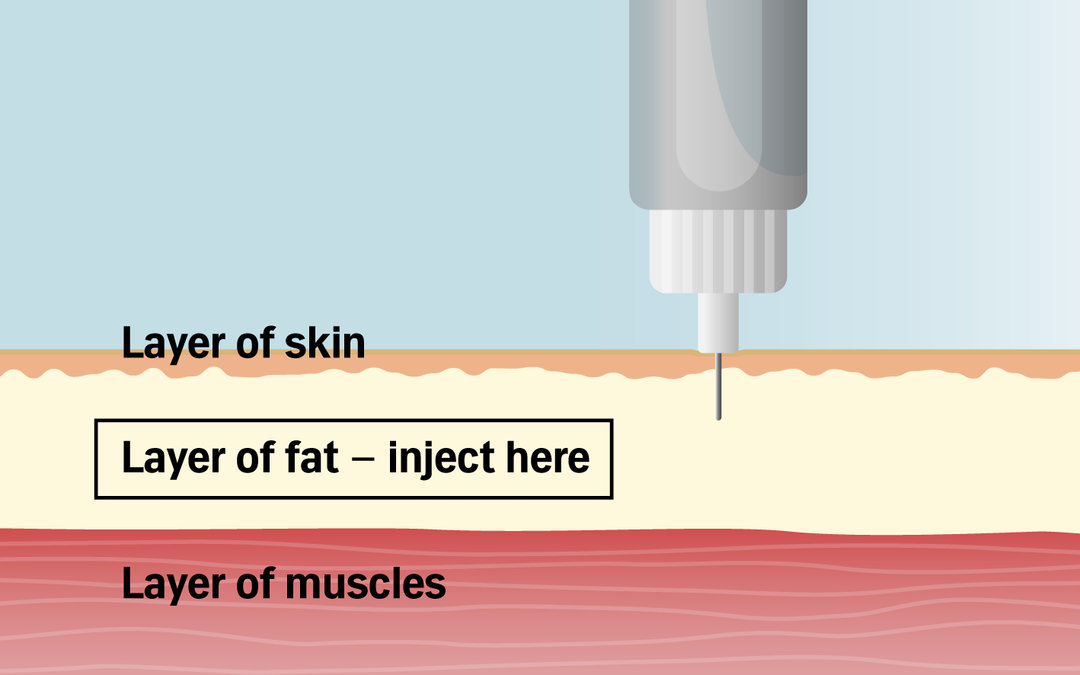 Your medication must be injected into the subcutis layer of fat
 Preparation
- Use a new needle each time.
- Choose a 4 millimeter needle. Use of a 4 millimeter needle is recommended for all adults regardless of age, gender, ethnicity, and BMI.
- Screw the needle onto the pen. Remove the protective cap from the needle.
- Test the pen: Insulin and GLP 1 pens must be tested prior to each injection to secure that there is there is a hole through the needle and that it will be filled prior to use. Set the pen to 1-2 units (insulin) or to the set-up symbol is opposite the marker (GLP 1). Hold down the needle into the largest protection cap and push down the plunger. When you see a drop at the tip of the needle, the pen will be ready for use. If you see no drop at the tip of the needle, repeat the test.
- Now set the pen to the planned dose.
Injection
- Inject in a vertical position (90 degrees) into level skin. Do not press the pen against the skin so hard that it creates an indentation in the skin.
Push down the plunger. To ensure that you will get your planned dosage in its entirety, you must push down the plunger and slowly count 10, before withdrawing the needle.
Put the exterior protection cap on the needle. Then, remove the needle from the pen and dispose of it in a sharps bin.
If you need a larger dosage of insulin, your therapist may recommend that you divide the dosage in two. This may improve your absorption of insulin which will thus be more effective.
Injection into a raised fold of the skin
If you have a low BMI, or if – according to your therapist's assessment – you do not have much fatty tissue in the area of the injection, you should inject into a raised fold of skin, such as it is shown in the drawing on page 3.
- Gently pinch a portion of skin between thumb and forefinger and insert the needle (at a 90-degree angle) at the tip of the skin fold (see drawing).Do not press the pen against the skin so hard that it creates an indentation in the skin.
- Keep the skin fold raised and count slowly to 10 before removing the needle.
- Subsequently, follow steps 2 and 3 in the section "Injection".
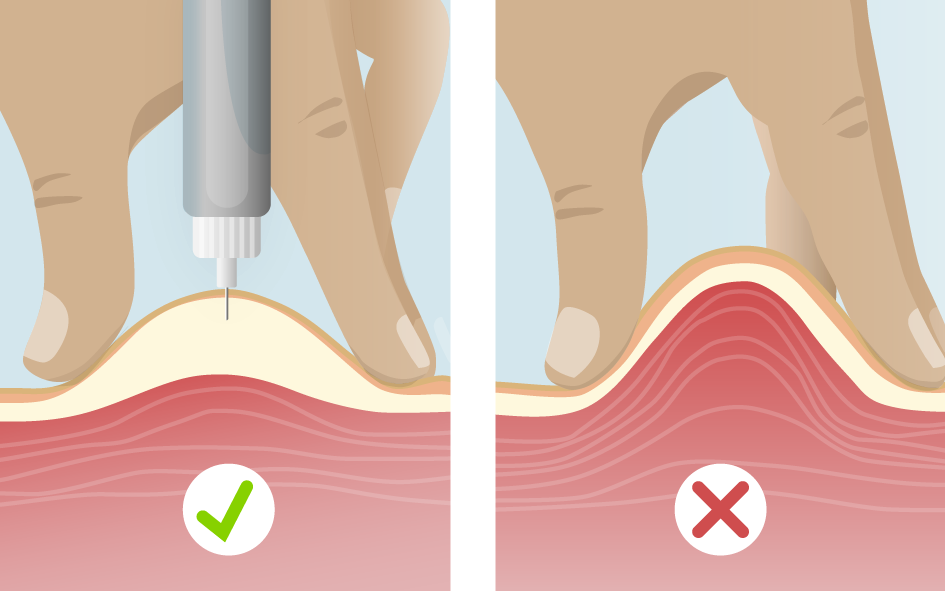 Be sure not to include muscle tissue when pinching up a fold of skin
 Avoid infiltrates
If you repeatedly inject insulin or GLP-1 into the same area, there is a risk of infiltrates, callosity or hard areas in the fatty tissue.
To avoid this, you can do the following:
- Inject with at least 1-2 centimeters of distance from the last injection site.
- Use a new needle every time you take insulin or GLP-1.
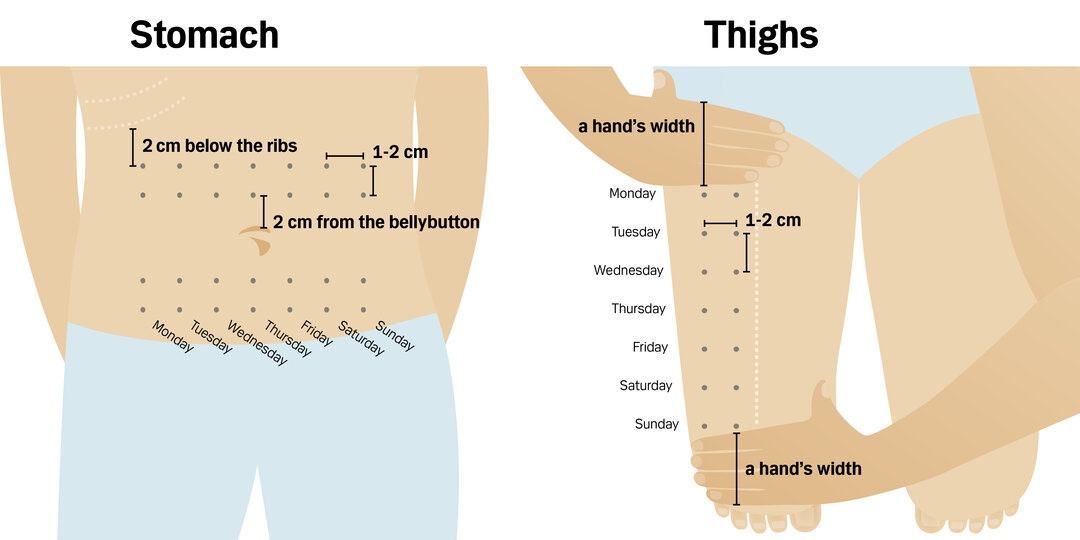 How you can profit from changing injection place.
 The areas of stomach and thigh, as shown in the drawings above, are the areas that are most generally applied for the injection of insulin and GLP 1. However, upper arms and buttocks can also be used. Talk to your healthcare provider about injection sites.
In the leaflet, 'Where on your body to distribute insulin and GLP 1 injections', which you find on www.sdcc.dk you can learn about how you best distribute your injections.
If you suspect infiltrates, callosity or hard areas, you should avoid injection into this area and discuss the issue with your practitioner at your next visit.
General recommendations
- Unopened insulin and GLP-1 must be stored in the refrigerator door or in a box in the refrigerator. Take out a new pen well in advance, in order that it will have room temperature when it is to be used.
- Pens that have been taken into use must be kept at room temperature and always with the pen's protective cap on to protect the contents against light.
- You should take care to check that the pen's best-before-date has not expired when you use the pen.
- Certain insulin types must be mixed or taken within a certain area.
- When the plunger of pens with insulin that is to be mixed before use has passed the last measure, the dosage may become imprecise. Thus the pen should be discarded.
- If the content of an insulin or GLP 1 pen has changed colour, has passed the best-before date, or has been stored in a place that is too hot or too cold (according to the patient information leaflet), the pen must be discarded.
- Empty pens and used needles contain medicinal residue. They must therefore be handed in at your pharmacy for correct disposal.
- Sharps containers can be obtained at the pharmacy. Full sharps containers are handed in at the pharmacy.
Contact
If you have questions or doubts, you are welcome to contact Sygeplejerådgivningen by telephone 39 68 08 00 on weekdays from 08:00-16:00.